

Basket
Loading...

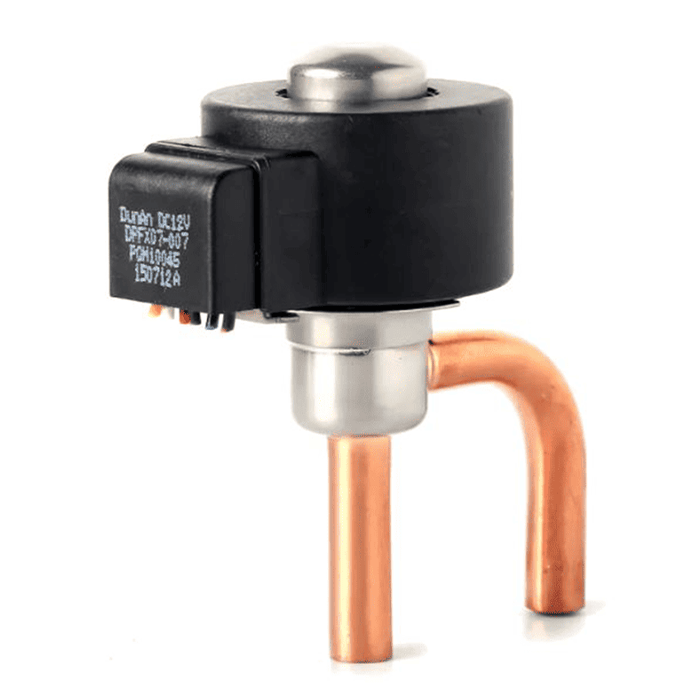
The DSF Series Electronic Expansion Valve is a high-performance component designed to precisely regulate refrigerant flow in cooling and refrigeration systems. It features a stepper motor and a valve needle with a magnetic rotor, driven by a coil that receives pulse signals from the controller. These signals enable the stepper motor to rotate, and through a transmission screw mechanism, this rotary motion is converted into linear axial movement of the valve needle. This movement adjusts the flow area of the valve port, ensuring accurate and efficient control of the refrigerant flow rate. The expansion valve is a critical component for controlling refrigerant flow, reducing pressure, and ensuring efficient heat transfer in the evaporator. Operating a system without a functional expansion valve would result in poor performance, increased risk of damage, and potential failure.
Read more below for the full selection table, coil parameters, flow characteristics and nominal capacity, or get in touch for more indepth system technical advice.
Unlike thermostatic expansion valves (TEVs), electronic expansion valves do not rely on mechanical sensing but use electronic feedback, making them more accurate and suitable for modern systems that prioritise energy efficiency and advanced controls. By enabling precise refrigerant management, EEVs play a vital role in improving the efficiency and reliability of commercial refrigeration systems.
An electronic expansion valve (EEV) is a critical component in commercial refrigeration systems. It precisely regulates the flow of refrigerant into the evaporator coil to optimize performance and efficiency. The EEV manages the refrigerant flow based on real-time system conditions, improving energy efficiency and ensuring stable cooling. It replaces traditional mechanical expansion valves, offering finer control and adaptability to changing loads.
DPF series electronic expansion valves offer bidirectional operation to control the refrigerant flow rate in reversible systems. By enabling optimised flow paths within the system, they offer fast cooling or heating, precise temperature control, energy savings and noise reduction.
Contact our team on 01782 618 444 for availability and costs.
| Model | Orifice | Air Flow (0.1MPa) | Flow Type | Internal Leakage | Reverse OPD | MOPD | Max. Operating Pressure | |
| 250 Pulses | 500 Pulses | |||||||
| (mm) | (L/min) | (L/min) | (mL/min) | (MPa) | (MPa) | (MPa) | ||
| DPF (B) 1.0 - 101 | 1.0 | 9 | >12 | 1 | <600 | >2.2 | 3.5 | 4.5 |
| DPF (B) 1.0 - 103 | 6 | 2 | ||||||
| DPF (B) 1.0 - 105 | 9 | 1 | ||||||
| DPF (B) 1.0 - 106 | 6 | 2 | ||||||
| DPF (B) 1.3 - 101 | 1.3 | 16 | >21 | 1 | ||||
| DPF (B) 1.3 - 103 | 8.5 | 2 | ||||||
| DPF (B) 1.3 - 105 | 16 | 1 | ||||||
| DPF (B) 1.3 - 106 | 8.5 | 2 | ||||||
| DPF (B) 1.65 - 101 | 1.65 | 25 | >34 | 1 | ||||
| DPF (B) 1.65 - 103 | 11 | 2 | ||||||
| DPF (B) 1.65 - 105 | 25 | 1 | ||||||
| DPF (B) 1.65 - 106 | 11 | 2 | ||||||
| DPF (B) 1.8 - 101 | 1.8 | 31 | >45 | 1 | ||||
| DPF (B) 1.8 - 103 | 13 | 2 | ||||||
| DPF (B) 1.8 - 105 | 31 | 1 | ||||||
| DPF (B) 1.8 - 106 | 13 | 2 | ||||||
| DPF (B) 2.0 - 101 | 2.0 | 40 | >50 | 1 | ||||
| DPF (B) 2.0 - 103 | 16 | 2 | ||||||
| DPF (B) 2.0 - 105 | 40 | 1 | ||||||
| DPF (B) 2.0 - 106 | 16 | 2 | ||||||
| DPF (B) 2.2 - 101 | 2.2 | 45 | >60 | 1 | ||||
| DPF (B) 2.2 - 103 | 19 | 2 | ||||||
| DPF (B) 2.2 - 105 | 45 | 1 | ||||||
| DPF (B) 2.2- 106 | 19 | 2 | ||||||
| DPF (B) 2.4- 101 | 2.4 | 55 | >74 | 1 | <1000 | >1.5 | 2.8 | |
| DPF (B) 2.4 - 103 | 23 | 2 | ||||||
| DPF (B) 2.4 - 105 | 55 | 1 | ||||||
| DPF (B) 2.4 - 106 | 23 | 2 | ||||||
| DPF (B) 2.6 - 101 | 2.6 | 60 | >82 | 1 | ||||
| DPF (B) 2.6 - 103 | 28 | 2 | ||||||
| DPF (B) 2.6 - 105 | 60 | 1 | ||||||
| DPF (B) 2.6 - 106 | 28 | 2 | ||||||
| DPF (B) 2.8 - 101 | 2.8 | 67 | >95 | 1 | ||||
| DPF (B) 2.8 - 103 | 29 | 2 | ||||||
| DPF (B) 2.8 - 105 | 67 | 1 | ||||||
| DPF (B) 2.8 - 106 | 29 | 2 | ||||||
| DPF (B) 3.0 - 101 | 3.0 | 79 | >105 | 1 | ||||
| DPF (B) 3.0 - 103 | 31 | 2 | ||||||
| DPF (B) 3.0 - 105 | 79 | 1 | ||||||
| DPF (B) 3.0 - 106 | 31 | 2 | ||||||
| DPF (B) 3.2 - 101 | 3.2 | 91 | >115 | 1 | ||||
| DPF (B) 3.2 - 103 | 33 | 2 | ||||||
| DPF (B) 3.2 - 105 | 91 | 1 | ||||||
| DPF (B) 3.2 - 106 | 33 | 2 | ||||||
| DPF (B) 3.5C - P001 | 3.5 | 95 | >113 | 1 | ||||
| DPF (B) 4.0C - P001 | 4.0 | 135 | >213 | 1 | < 1500 | >2.2 | 3.5 | |
| DPF (B) 4.5C - P001 | 4.5 | 180 | >268 | 1 | ||||
| DPF (B) 5.5C - P001 | 5.5 | 245 | >397 | 1 | ||||
| DPF (B) 6.5C - P001 | 6.5 | 260 | >483 | 1 | ||||
Like any mechanical or electronic component, expansions valves can experience wear and tear, mechanical issues, or electronic malfunctions over time. Signs of a failing expansion valve include inconsistent cooling or heating performance, as the evaporator may receive too much or too little refrigerant, leading to inadequate operation. Frost build-up on the coil or refrigerant lines can occur if the valve sticks open, allowing excess refrigerant into the evaporator. High or low superheat levels may result from the valve being stuck closed or open, causing improper refrigerant flow. Erratic system pressures and unusual noises, such as clicking, buzzing, or hissing near the valve, can also indicate a problem. Additionally, compressor issues like flooding or starvation may arise, potentially leading to damage or unusual operating noises. If any of these symptoms appear, the expansion valve should be inspected and addressed promptly.
